When most people think about car care for a prestige vehicle, they think about the big jobs — paint correction, ceramic coating, full interior restoration. And those services absolutely matter. But there’s a quieter, less glamorous process that sits underneath all of it, and without it, even the most expensive paint protection in the world won’t perform the way it should.
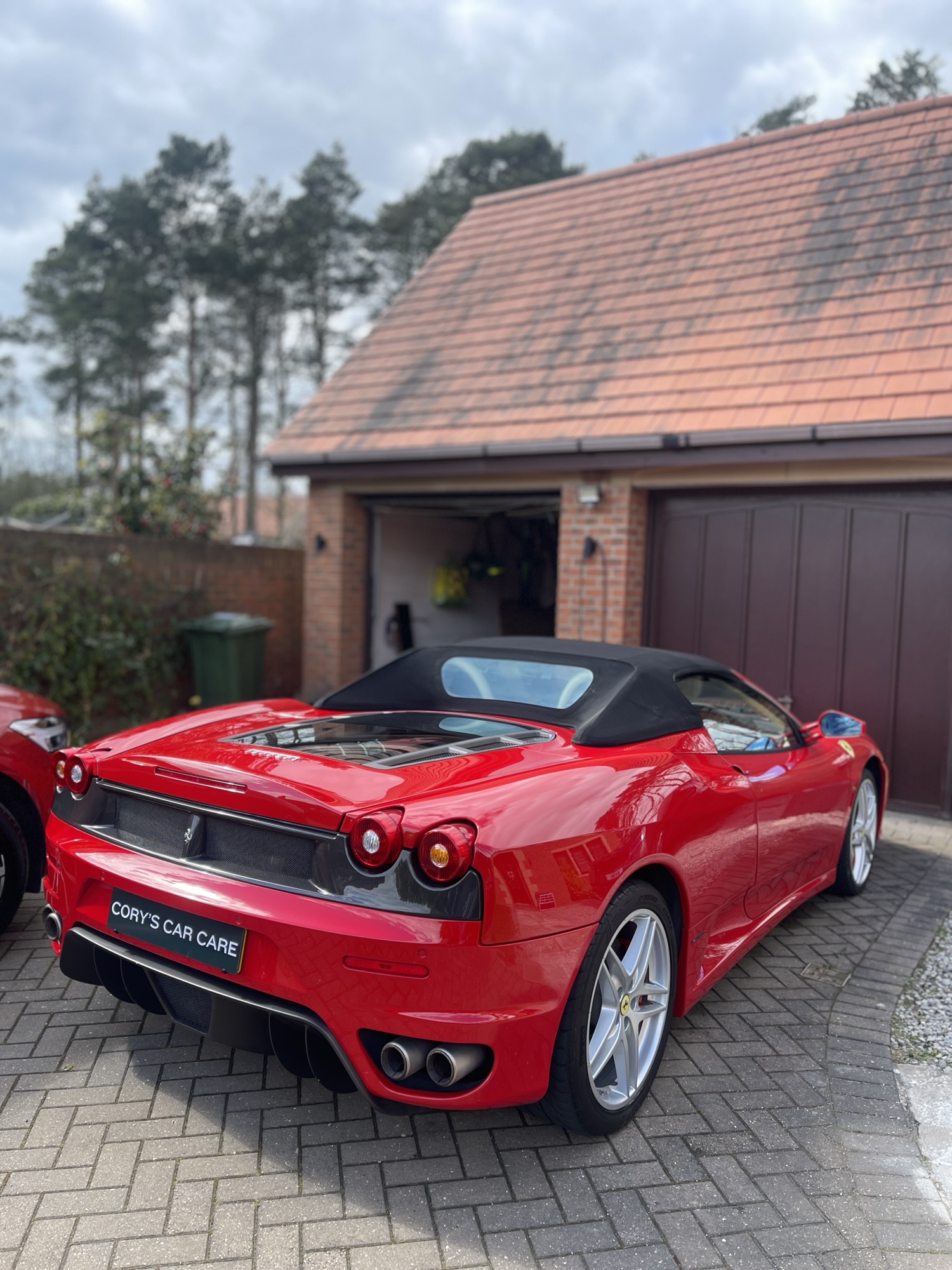
That process is decontamination. And this Ferrari F430 is a perfect example of why it matters.
The Car
The Ferrari F430 needs little introduction. Produced between 2004 and 2009, it remains one of the most celebrated Ferraris of the modern era — a 4.3-litre V8, 483bhp, and bodywork that turns heads two decades after it rolled out of Maranello. Owners of cars like this tend to take their vehicle care seriously, and rightly so.
This particular F430 came to us for an exterior detail. On the surface it looked clean and well-maintained. But looks can be deceiving — and that’s precisely the point of this post.
What Is Paint Decontamination and Why Does It Matter?
Your car’s paintwork collects two types of contamination over time: chemical and physical.
Chemical contamination includes iron fallout from brake dust and rail dust, industrial pollution, bird dropping residue, and tree sap. These contaminants bond with the paint surface at a microscopic level. A normal wash — no matter how thorough — won’t remove them.
Physical contamination includes embedded particles of grit, tar, and road debris that bond to the clear coat and create a rough texture you can actually feel when you run your hand across the panel.
Left untreated, both types of contamination cause long-term damage. Iron particles in particular are acidic — they slowly oxidise and eat into the clear coat from within, causing the kind of paint degradation that can only be fixed with correction work.
The irony is that the better your paintwork, the more visible contamination becomes. On a dark, well-maintained car like the F430, iron fallout and surface roughness are immediately obvious to a trained eye.
What We Did
Iron Fallout Removal
The first step was an iron fallout remover applied across all painted surfaces, glass and alloy wheels. This is one of those satisfying processes to watch — the product reacts with ferrous contamination and turns a deep purple as it dissolves and lifts the particles. On a car of this age and mileage, the reaction was significant, confirming what we suspected: the paintwork was carrying a substantial contamination load despite appearing clean.
Chemical Decontamination
Following the iron treatment, a full chemical decontamination wash was carried out to remove remaining bonded contaminants — tar, industrial fallout, and anything the iron remover had loosened but not fully lifted. This step ensures the paint surface is chemically clean before any physical work begins.
Clay Bar Treatment
With the chemical contamination addressed, we moved to a clay bar treatment across all exterior panels. Clay barring physically removes embedded particles from the clear coat, restoring a smooth, clean surface. If you’ve never felt the difference before and after a clay bar treatment, it’s remarkable — running your hand across a properly clayed panel feels like glass.
This step is also essential as preparation for any protective product. Applying a sealant or wax to contaminated paint is like painting over a dirty wall — the product can’t bond properly and its durability will be significantly reduced.
Spray Sealant Application
With the paintwork now clean and properly prepared, we finished with a professional spray sealant to lock in the results. The sealant adds a layer of protection against environmental contaminants, UV exposure and light water spotting, buying the paint time between more comprehensive treatments.
How Often Does a Prestige Car Need This?
As a general guide:
- Every 3–4 months for daily-driven prestige vehicles or cars parked outside
- Every 6 months for garaged vehicles with limited mileage
- Before any paint correction or ceramic coating — without exception
The more frequently you decontaminate, the less correction work your paint will ever need. Catching contamination early is significantly cheaper than correcting the damage it causes over time.
The Bigger Picture
The F430 left looking exactly as it should — immaculate, protected, and with paintwork that now has a clean foundation to build from. The owner is considering a full paint correction and ceramic coating later in the year, and thanks to this work, the paint will be in the best possible condition when that time comes.
If you own a performance, classic or prestige vehicle in Wynyard, Gosforth, Ponteland, Durham or the surrounding North East, regular decontamination should be part of your car care routine — not an afterthought.
Book your exterior detail or decontamination treatment at coryscarcare.co.uk
Cory’s Car Care is a fully insured mobile detailing specialist serving Wynyard and the North East, specialising in machine paint correction, ceramic coating and prestige vehicle care.
Leave a Reply